Being Mindful about Food Waste
Each year, on April 22, Earth Day is celebrated to honor our planet and to raise awareness about the many environmental issues it faces. Here at Spoonfuls, we celebrate Earth Day everyday through food recovery. We keep perfectly fresh food out of landfills and prevent thousands of metric tons of CO2 equivalents from entering the atmosphere as that food breaks down. Mitigating greenhouse gas emissions, however, is just one part of the big picture of environmental protection. Preventing food waste can also be a practice in mindfulness. It invites us to consider where food should go instead of the trash, and it is this consideration that is fundamental in shifting our attitude toward consumption. How did that food even get to your plate in the first place? Who put it there?
Since I joined Spoonfuls as a Food Recovery Coordinator in 2025, I have witnessed some of the behind-the-scenes of the food system. The food system, as it currently operates for a majority of consumers in the United States, requires a global supply chain of many different actors to ultimately stock the food we see at the grocery store. Bananas, for instance, only grow in tropical climates yet are supplied in nearly every supermarket across the U.S. How can that be? As silly as it sounds, we know it was not put there by coincidence, nor created by a machine. Somebody somewhere on our shared planet put a seed in the Earth, watered it, and fertilized the soil, to produce the fruit we know and love. It was then harvested and packed and shipped across great distances to, hopefully, reach its final destination in someone’s hand. While the food system is massive and convoluted and operates on a gigantic scale, it is important to stay grounded in this principle that every meal we have the privilege to enjoy is dependent upon the work of someone else. Unfortunately, we do not see all those people who cultivated our fruits and vegetables and brought them to our convenience. We only see the visual of a completely stocked produce department, a visual that we take for granted. Perhaps that is by design.
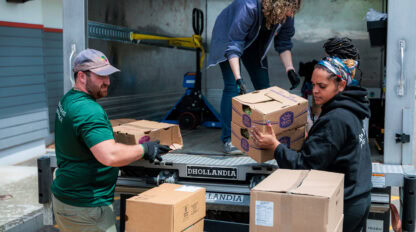
The global food system operates on overconsumption and positions consumers to think of food as a commodity, rather than a need and something we all have the right to. Food retailers stock up on the best and the newest to meet consumer demand and make a profit, thus they’re fully stocked at all times, sometimes turning over product before they actually need to. This practice requires stores to constantly supply more than they will realistically sell, and the byproduct is the risk of waste — and partnering with a food recovery like Spoonfuls is a tool they have for preventing it. I see it up close each day. It is my responsibility to communicate with store departments to keep items like deliberately cut bowls of fruit and delicately iced cakes from the bakery, out of trash bins so our team can recover them. I am lucky to bring such quality creations to places where they will be enjoyed as intended while they’re still good to eat.
It is not our fault that we live in a world of excess, but that also doesn’t mean we can’t do anything about it. Every choice matters. Shopping small and local is a great start, but when that is not possible, we can still ground ourselves by restoring food’s inherent value in our lives. When we prevent food waste, we honor the labor of someone else by nourishing our own bodies with it. When we prevent food waste, we give respect back to food, to ourselves, to each other, and to our planet.